

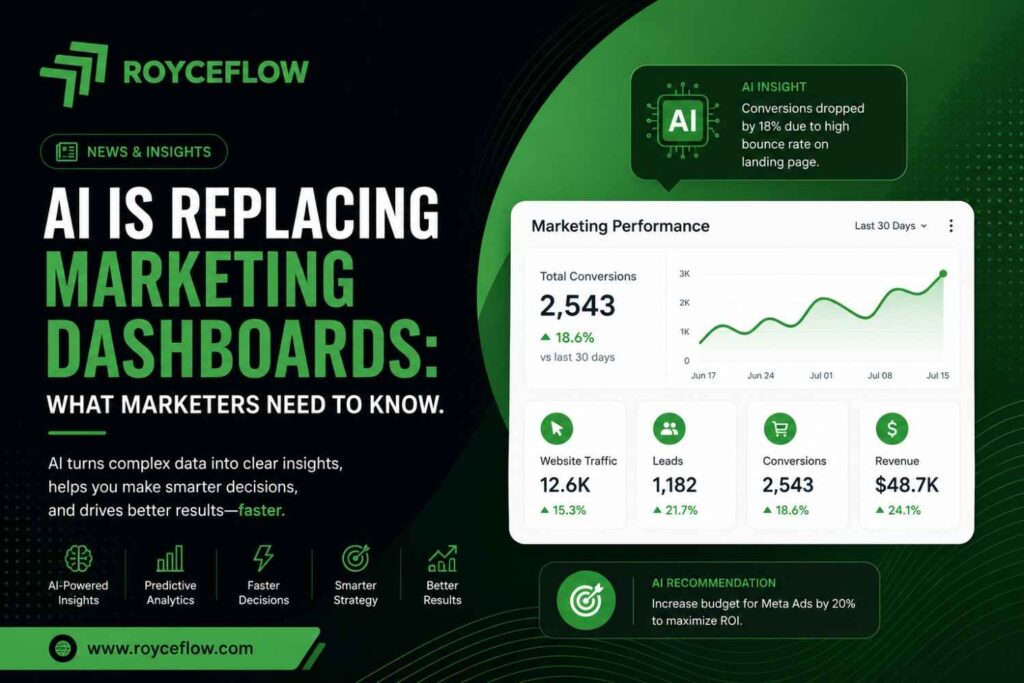
AI Is Replacing Marketing Dashboards here’s what you need to know. For years, marketing dashboards have been the go-to solution for tracking campaign performance. They helped teams monitor website traffic, ad spend, conversions, and customer engagement in one place. But as artificial intelligence becomes a core part of marketing workflows, many businesses are starting to rely less on dashboards and more on AI-powered insights.
Rather than spending hours filtering reports and comparing metrics, marketers can now ask AI simple questions like, “Why did conversions drop this week?” or “Which campaign generated the highest ROI?” AI can analyze multiple data sources, identify trends, explain performance changes, and even recommend the next steps within seconds.
Why Traditional Dashboards Are Losing Their Edge
Marketing dashboards are excellent at displaying data, but they still require someone to interpret what the numbers mean. As businesses collect more data than ever before, manually analyzing charts and reports has become increasingly time-consuming.
Some of the biggest challenges with traditional dashboards include:
- Information overload from multiple reports.
- Time spent searching for insights instead of acting on them.
- Difficulty identifying hidden trends.
- Limited predictive capabilities.
- Manual report creation for stakeholders.
While dashboards remain valuable for monitoring key metrics, they often answer what happened, not why it happened or what should happen next.
How AI Is Changing Marketing Analytics
AI is shifting analytics from reporting to decision-making.
Modern AI tools can:
- Summarize campaign performance in plain language.
- Detect unusual changes in traffic or conversions.
- Predict future performance using historical data.
- Recommend budget reallocations.
- Identify audience segments with the highest potential.
- Generate automated reports for teams and clients.
Instead of reading dozens of charts, marketers receive actionable insights immediately.
What This Means for Marketing Teams
The role of marketers is evolving. Rather than spending hours building reports, teams can focus more on strategy, creativity, and optimization while AI handles much of the data analysis.
Businesses adopting AI-powered analytics are likely to benefit from:
- Faster decision-making.
- Improved campaign optimization.
- Better customer understanding.
- Reduced reporting time.
- Increased marketing efficiency.
Are Dashboards Going Away?
Not entirely.
Dashboards will continue to play an important role in visualizing performance metrics, executive reporting, and real-time monitoring. However, they are becoming part of a larger AI-driven workflow instead of being the primary source of decision-making.
The future is likely to combine dashboards with AI assistants that can explain results, answer questions, and recommend actions automatically.
Looking Ahead
As AI capabilities continue to improve, marketers will spend less time interpreting data and more time implementing strategies that drive growth. Organizations that embrace AI-assisted analytics today will be better positioned to make faster, smarter, and more informed marketing decisions in the years ahead.
Key Takeaway
Marketing dashboards aren’t disappearing—but their role is changing. AI is transforming analytics from static reporting into intelligent decision support, helping marketers move from simply viewing data to acting on meaningful insights.