

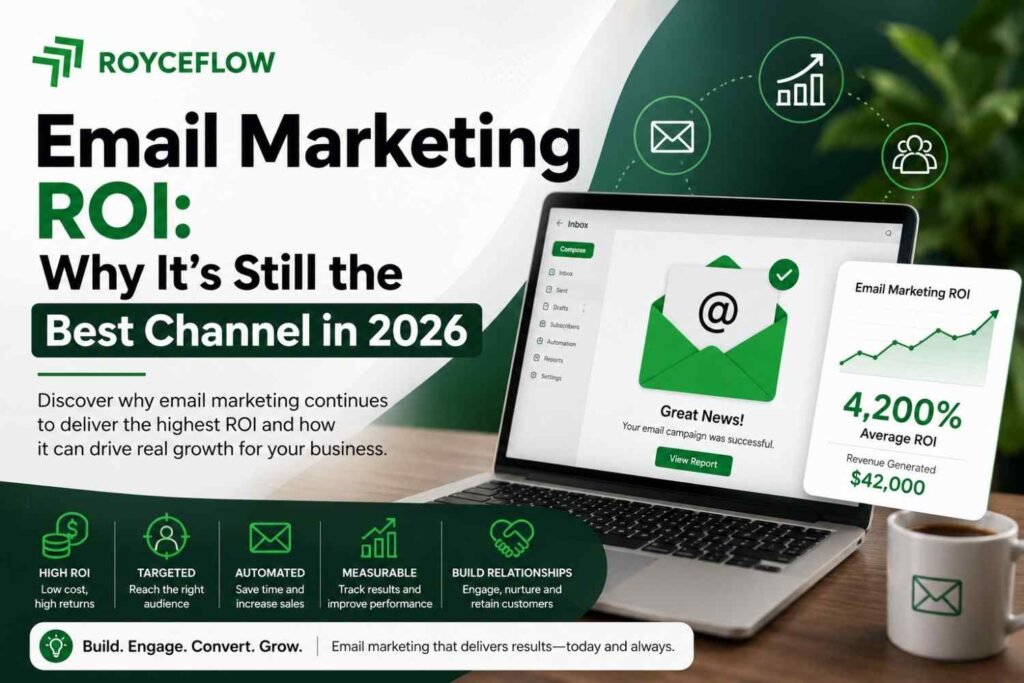
Despite the rise of artificial intelligence, social media platforms, influencer marketing, and paid advertising, email marketing continues to deliver one of the highest returns on investment (ROI) in digital marketing. Businesses of all sizes rely on email to build relationships, nurture leads, increase sales, and retain customers—all without depending on ever-changing algorithms.
In this guide, you’ll discover why email marketing remains one of the most profitable marketing channels in 2026 and how you can maximize its ROI for your business.
What Is Email Marketing?
Email marketing is the process of sending targeted messages to subscribers who have chosen to receive updates from your business.
These emails may include:
- Newsletters
- Promotional campaigns
- Product launches
- Educational content
- Welcome emails
- Transactional emails
- Event invitations
- Customer follow-ups
- Seasonal offers
Unlike social media, your email list is an owned marketing asset that you control.
Why Email Marketing Still Dominates in 2026
Consumer behavior continues to evolve, but email remains a daily habit for billions of users worldwide.
Businesses continue investing in email marketing because it offers:
- High return on investment
- Direct customer communication
- Personalized messaging
- Strong customer retention
- Better lead nurturing
- Increased sales opportunities
- Measurable performance
Email allows brands to reach customers without relying on social media algorithms or rising advertising costs.
Benefits of Email Marketing
Email marketing offers advantages that few other channels can match.
Some of the biggest benefits include:
- Cost-effective campaigns
- Highly targeted messaging
- Easy automation
- Scalable communication
- Strong customer relationships
- Increased repeat purchases
- Better conversion rates
- Actionable performance data
Whether you’re a startup or an enterprise, email marketing can support every stage of the customer journey.
Why Email Marketing Delivers Exceptional ROI
Several factors contribute to email marketing’s impressive performance.
You Own Your Audience
Unlike social media platforms, where algorithms determine visibility, your email list belongs to your business.
You can communicate directly with subscribers whenever needed.
Low Marketing Costs
Compared to paid advertising, email marketing is relatively inexpensive.
You don’t pay for every click or impression, making it one of the most budget-friendly marketing channels available.
Highly Personalized Campaigns
Modern email platforms allow businesses to personalize emails using:
- Customer names
- Purchase history
- Browsing behavior
- Location
- Interests
- Previous interactions
Personalized emails generally receive higher engagement and conversion rates.
Marketing Automation
Automation saves time while improving customer experiences.
Popular automated email sequences include:
- Welcome emails
- Lead nurturing campaigns
- Abandoned cart reminders
- Birthday offers
- Re-engagement campaigns
- Post-purchase follow-ups
- Feedback requests
Automation ensures consistent communication without manual effort.
Build Strong Customer Relationships
Email marketing isn’t only about selling.
It helps businesses:
- Educate customers
- Share valuable content
- Build trust
- Provide updates
- Offer exclusive insights
- Reward loyal customers
Strong relationships often lead to repeat purchases and long-term customer loyalty.
Segment Your Audience
Sending the same email to every subscriber is no longer effective.
Create audience segments based on:
- Demographics
- Interests
- Purchase history
- Customer lifecycle
- Industry
- Engagement level
- Geographic location
Segmentation increases relevance and improves campaign performance.
Optimize Email Subject Lines
Your subject line determines whether subscribers open your email.
Effective subject lines should be:
- Short
- Clear
- Relevant
- Personalized
- Curiosity-driven
- Benefit-focused
Avoid misleading clickbait or excessive capitalization.
Create Valuable Content
Every email should provide value.
Popular email content includes:
- Industry insights
- Educational guides
- Product tutorials
- Customer success stories
- Exclusive offers
- Company updates
- Blog articles
- Event announcements
Focus on helping subscribers rather than constantly selling.
Mobile Optimization Is Essential
A large percentage of emails are opened on smartphones.
Ensure your emails:
- Use responsive layouts
- Have readable font sizes
- Include clickable buttons
- Load quickly
- Display correctly on all devices
A poor mobile experience can reduce engagement and conversions.
Track Email Marketing Performance
Measure campaign success using key performance indicators (KPIs).
Monitor metrics such as:
- Open rate
- Click-through rate (CTR)
- Conversion rate
- Bounce rate
- Unsubscribe rate
- Revenue generated
- List growth rate
- Email deliverability
Regular analysis helps improve future campaigns.
Integrate Email with Other Marketing Channels
Email works even better when combined with:
- Content marketing
- SEO
- Social media
- Google Ads
- Webinars
- Landing pages
- CRM systems
An integrated marketing strategy creates a seamless customer experience.
Common Email Marketing Mistakes
Avoid these mistakes:
- Buying email lists
- Sending too many emails
- Ignoring personalization
- Weak subject lines
- Poor mobile design
- Large image files
- No clear call-to-action
- Sending irrelevant content
- Ignoring analytics
- Inconsistent email schedules
Avoiding these issues improves engagement and protects your sender reputation.
Best Email Marketing Practices for 2026
Follow these proven practices:
- Build your email list organically
- Segment your audience
- Personalize campaigns
- Use automation wisely
- Test subject lines
- Optimize for mobile devices
- Keep email designs simple
- Include clear calls-to-action
- Monitor campaign performance
- Continuously improve based on data
Consistency and relevance are the keys to long-term success.
Best Email Marketing Tools
Popular platforms include:
- Mailchimp
- Brevo
- HubSpot
- ActiveCampaign
- Klaviyo
- ConvertKit
- Constant Contact
- GetResponse
- Campaign Monitor
- MailerLite
Choose a platform based on your business size, automation needs, and budget.
Frequently Asked Questions
Is email marketing still effective in 2026?
Yes. Email marketing continues to be one of the highest-performing digital marketing channels because it enables direct, personalized communication with your audience and delivers strong long-term returns.
How often should businesses send marketing emails?
There is no universal schedule. Many businesses find success with one to four emails per month, while others send weekly updates. The ideal frequency depends on your audience, industry, and the value you provide.
What makes a successful email campaign?
A successful campaign combines a compelling subject line, valuable content, audience segmentation, personalization, mobile-friendly design, and a clear call-to-action.
Can small businesses benefit from email marketing?
Absolutely. Email marketing is affordable, scalable, and effective for businesses of all sizes. Even a small subscriber list can generate meaningful engagement and sales when nurtured consistently.
How can I improve my email marketing ROI?
Focus on growing your list organically, segmenting subscribers, personalizing content, automating follow-ups, testing campaigns, and analyzing performance metrics to continually refine your strategy.
Conclusion
In 2026, email marketing remains one of the most reliable and profitable digital marketing channels available. While trends and platforms continue to change, email provides something few other channels can offer: direct access to an audience that has chosen to hear from your business. This ownership, combined with personalization, automation, and measurable performance, makes email an essential part of any successful marketing strategy.
Businesses that invest in delivering valuable content, building authentic subscriber relationships, and optimizing campaigns based on data will continue to see exceptional returns. Rather than viewing email as an outdated tool, forward-thinking organizations recognize it as a powerful engine for lead generation, customer retention, and long-term business growth.
