
Growing website traffic doesn’t always require a massive advertising budget. While paid ads can deliver quick results, sustainable growth comes from improving your website, creating valuable content, and optimizing your online presence. With the right strategy, it’s possible to significantly increase your website traffic in just 30 days using organic methods.
This guide outlines a practical, step-by-step plan to help you attract more visitors without spending money on ads.
Why Focus on Organic Traffic?
Organic traffic comes from search engines, social media, referrals, and direct visits rather than paid campaigns. It offers several long-term benefits:
- Lower customer acquisition costs
- Higher trust among users
- Sustainable traffic growth
- Better return on investment (ROI)
- Increased brand authority
- Consistent lead generation
Unlike paid ads, organic traffic continues to grow even after your initial efforts.
Week 1: Audit and Optimize Your Website
Before trying to attract more visitors, ensure your website provides a great user experience.
Improve Website Speed
A slow website increases bounce rates and hurts search rankings.
Optimize by:
- Compressing images
- Enabling browser caching
- Using a CDN
- Minimizing CSS and JavaScript
- Choosing reliable hosting
Aim for a page load time of under three seconds.
Make Your Website Mobile-Friendly
Most users browse on smartphones. Ensure your website:
- Uses responsive design
- Has readable fonts
- Features clickable buttons
- Loads quickly on mobile devices
- Provides easy navigation
Google also prioritizes mobile-friendly websites in search results.
Fix Technical SEO Issues
Check for:
- Broken links
- Missing meta descriptions
- Duplicate content
- Redirect errors
- Missing image alt text
- Incorrect heading structure
- XML sitemap issues
Technical SEO forms the foundation of organic growth.
Week 2: Publish High-Quality Content
Content remains one of the strongest drivers of organic traffic.
Target Long-Tail Keywords
Instead of competing for highly competitive keywords, focus on specific search phrases.
Examples:
- Best SEO tips for small businesses
- How to improve website speed
- Local SEO checklist
- Content marketing strategy for startups
These keywords often have lower competition and higher conversion rates.
Create Helpful Blog Posts
Write content that solves real problems.
Popular formats include:
- Step-by-step guides
- Tutorials
- Checklists
- Case studies
- Industry trends
- Beginner guides
- Frequently asked questions
Aim to publish two to four high-quality articles during the month.
Update Existing Content
Don’t ignore older articles.
Refresh them by:
- Adding recent statistics
- Updating screenshots
- Improving readability
- Expanding sections
- Adding internal links
- Optimizing keywords
Updated content often regains search rankings.
Improve On-Page SEO
Optimize every article with:
SEO-Friendly Titles
Create compelling titles that include your primary keyword.
Example:
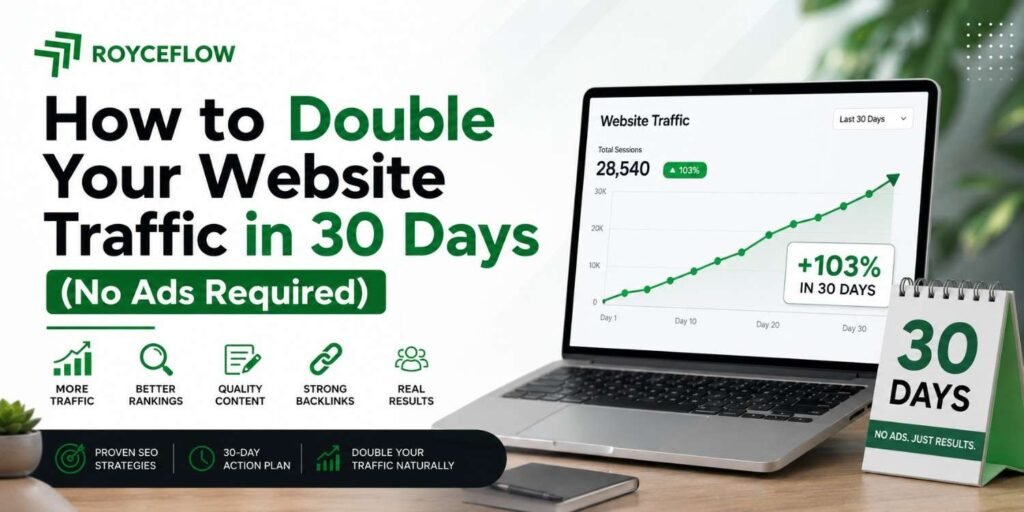
How to Double Your Website Traffic in 30 Days (No Ads Required)
Write Better Meta Descriptions
Your meta description should encourage users to click.
Include:
- Primary keyword
- Clear value proposition
- Strong call-to-action
Use Proper Heading Structure
Maintain a clean structure:
- One H1
- Multiple H2 headings
- H3 headings for subtopics
This improves both readability and SEO.
Optimize Images
Every image should have:
- Descriptive filenames
- Alt text
- Compressed file sizes
- Modern formats like WebP where possible
Images can also generate traffic through Google Images.
Build Internal Links
Internal linking helps search engines understand your website structure.
Link related articles naturally.
Example:
A blog about SEO can link to articles about:
- Keyword research
- Technical SEO
- Content marketing
- Local SEO
Internal links also encourage visitors to explore more pages.
Earn Quality Backlinks
Backlinks remain one of Google’s strongest ranking factors.
Organic ways to earn them include:
- Guest blogging
- Publishing original research
- Creating free resources
- Writing ultimate guides
- Sharing industry insights
- Building useful tools
Focus on quality rather than quantity.
Optimize for Local SEO
If you serve a local audience:
- Create a Google Business Profile
- Collect customer reviews
- Add location pages
- Use local keywords
- Maintain consistent business information
Local SEO helps you appear in nearby searches.
Share Content on Social Media
Every blog post deserves promotion.
Share across:
- X
- Threads
Repurpose one article into multiple content formats, such as short videos, infographics, or carousel posts.
Use Email Marketing
Email remains one of the highest-converting marketing channels.
Send newsletters containing:
- New blog posts
- Industry insights
- Helpful tips
- Free resources
Encourage subscribers to revisit your website regularly.
Improve Click-Through Rate (CTR)
Higher rankings don’t always guarantee more traffic.
Improve CTR by:
- Writing compelling titles
- Using numbers
- Adding power words
- Creating attractive meta descriptions
- Including current years when relevant
Better CTR often leads to more visitors without improving rankings.
Answer Questions Your Audience Is Asking
Create content around common customer questions.
Examples include:
- How much does SEO cost?
- What is content marketing?
- How long does SEO take?
- Is local SEO worth it?
Answering search intent increases your chances of ranking.
Track Your Results
Monitor your progress using tools like:
- Google Analytics
- Google Search Console
- Bing Webmaster Tools
- Ahrefs
- SEMrush
Key metrics include:
- Organic traffic
- Click-through rate
- Keyword rankings
- Bounce rate
- Average session duration
- Conversion rate
Use this data to refine your strategy.
30-Day Organic Traffic Action Plan
Days 1–7
- Audit your website
- Improve speed
- Fix technical SEO issues
- Optimize mobile experience
Days 8–14
- Publish two SEO-optimized blog posts
- Update existing articles
- Improve on-page SEO
Days 15–21
- Build internal links
- Promote content on social media
- Send an email newsletter
- Reach out for backlinks
Days 22–30
- Publish additional content
- Review analytics
- Optimize pages with high impressions but low CTR
- Continue building backlinks and updating content
Common Mistakes to Avoid
Avoid these mistakes if you want steady organic growth:
- Publishing low-quality content
- Ignoring keyword research
- Stuffing keywords unnaturally
- Not optimizing for mobile devices
- Neglecting technical SEO
- Forgetting internal links
- Publishing without promoting content
- Expecting overnight results
Consistency is the key to long-term success.
Frequently Asked Questions
Can I really double my website traffic without ads?
Yes. While results vary depending on your starting point, improving SEO, publishing valuable content, optimizing existing pages, and promoting your articles can significantly increase organic traffic.
How long does SEO take to show results?
Some improvements can be seen within a few weeks, but meaningful and lasting SEO results typically take three to six months. However, optimizing existing content and fixing technical issues can produce quicker gains.
How many blog posts should I publish?
Focus on quality over quantity. Publishing two to four comprehensive, well-optimized articles each month is often more effective than posting many low-quality pieces.
Is social media necessary for increasing website traffic?
Yes. Social media helps amplify your content, attract referral traffic, and build brand awareness, which can indirectly improve your SEO performance.
What is the most important factor for organic traffic?
Consistently creating valuable content that satisfies user intent, combined with strong technical SEO and quality backlinks, delivers the best long-term results.
Conclusion
Doubling your website traffic in 30 days without running ads is possible when you focus on sustainable organic marketing strategies. By improving your website’s performance, creating high-quality content, optimizing for search engines, strengthening internal linking, earning quality backlinks, and consistently promoting your content, you can build a steady stream of visitors that continues to grow over time.
Organic traffic is an investment rather than an expense. The effort you put into SEO and content marketing today can continue generating leads, customers, and business opportunities for months or even years. Stay consistent, track your progress, refine your strategy, and you’ll create lasting growth without relying on paid advertising.