
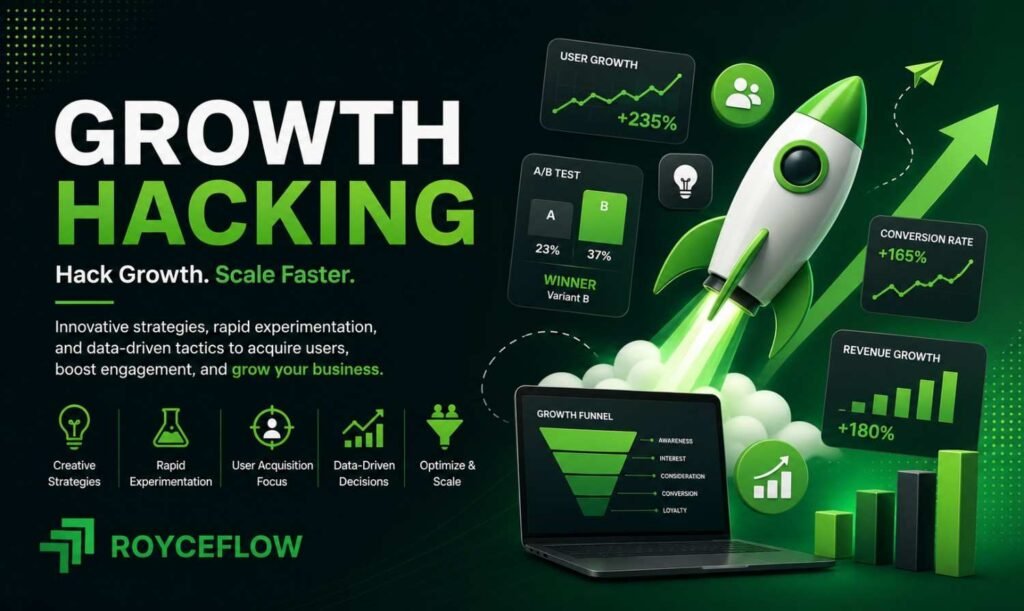
Growth hacking is a data-driven marketing approach focused on achieving rapid and sustainable business growth through continuous experimentation, creativity, and optimization. Unlike traditional marketing, growth hacking combines marketing, product development, analytics, and technology to discover the most effective ways to acquire, engage, and retain customers.
Originally popular among startups with limited budgets, growth hacking is now used by businesses of all sizes to scale faster and make informed decisions based on real data.
What is Growth Hacking?
Growth hacking is the process of using creative strategies, rapid experimentation, and data analysis to identify the most effective ways to grow a business.
Instead of relying on a single marketing channel, growth hackers continuously test ideas across acquisition, activation, retention, revenue, and referrals to improve overall business performance.
The primary goal is to achieve maximum growth with minimal resources.
Why is Growth Hacking Important?
Businesses operate in highly competitive markets where traditional marketing alone may not deliver the desired results. Growth hacking focuses on continuous improvement by identifying opportunities that increase customer acquisition, improve conversions, and maximize retention.
Key benefits include:
- Faster business growth
- Lower customer acquisition costs
- Better conversion rates
- Data-driven decision making
- Improved customer retention
- Increased revenue
- Scalable marketing strategies
- Continuous optimization
The Growth Hacking Process
Successful growth hacking follows a structured framework.
Define Growth Goals
Set measurable objectives such as increasing website traffic, generating leads, improving conversion rates, or growing revenue.
Related Article: Growth Strategy
Research Your Audience
Understand customer behavior, challenges, and motivations before testing new ideas.
Related Article: Customer Research
Generate Growth Ideas
Brainstorm multiple strategies for improving acquisition, engagement, or retention.
Examples include:
- Landing page improvements
- Email campaigns
- Referral programs
- Content marketing
- Product improvements
- Social media campaigns
Experiment
Run small, controlled experiments to validate ideas before implementing them on a larger scale.
Common experiments include:
- A/B Testing
- CTA optimization
- Pricing tests
- Headline variations
- Landing page redesigns
Related Article: A/B Testing
Analyze Results
Measure experiment performance using analytics and key performance indicators (KPIs).
Scale Successful Strategies
Implement experiments that produce positive results and continue optimizing them over time.
The Growth Hacking Funnel
Growth hackers often use the AARRR framework.
Acquisition
Attract new visitors through SEO, content marketing, social media, paid advertising, partnerships, and referrals.
Activation
Help new users experience the value of your product or service as quickly as possible.
Retention
Encourage users to return through email marketing, personalized experiences, and ongoing engagement.
Revenue
Convert users into paying customers and increase customer lifetime value.
Referral
Encourage satisfied customers to recommend your business to others.
Common Growth Hacking Strategies
Businesses use various growth techniques depending on their goals.
Popular strategies include:
- Content Marketing
- SEO
- Referral Marketing
- Email Marketing
- Landing Page Optimization
- Product-Led Growth
- Viral Marketing
- Community Building
- Influencer Marketing
- Partnership Marketing
Growth Hacking Channels
Growth can come from multiple digital channels.
- Search Engines
- Social Media
- Email Marketing
- Organic Content
- Paid Advertising
- Communities
- Affiliate Marketing
- Online Events
- Product Integrations
Growth Hacking Metrics
Tracking performance is essential.
Common metrics include:
- Customer Acquisition Cost (CAC)
- Customer Lifetime Value (CLV)
- Conversion Rate
- Churn Rate
- Monthly Active Users (MAU)
- Daily Active Users (DAU)
- Website Traffic
- Lead Generation
- Revenue Growth
- Referral Rate
Growth Hacking Tools
Popular tools include:
- Google Analytics
- Google Search Console
- Hotjar
- Microsoft Clarity
- HubSpot
- Ahrefs
- Semrush
- Mailchimp
- Canva
- Notion
Best Practices
Successful growth hackers follow these principles:
- Make decisions based on data
- Test one variable at a time
- Focus on customer experience
- Track meaningful metrics
- Optimize continuously
- Learn from failed experiments
- Prioritize high-impact opportunities
- Scale only proven strategies
Common Mistakes
Avoid these common pitfalls:
- Making decisions without data
- Testing too many variables at once
- Ignoring customer feedback
- Chasing vanity metrics
- Scaling unsuccessful experiments
- Neglecting user retention
- Failing to document experiments
- Giving up too early
Frequently Asked Questions
What is growth hacking?
Growth hacking is a process of using experimentation, data, and creative marketing techniques to accelerate business growth.
Is growth hacking only for startups?
No. Businesses of all sizes use growth hacking principles to improve customer acquisition, retention, and revenue.
What skills does a growth hacker need?
Growth hackers typically combine marketing, analytics, experimentation, problem-solving, and basic technical knowledge.
What’s the difference between growth hacking and digital marketing?
Digital marketing focuses on promoting products through digital channels, while growth hacking focuses on rapid experimentation and optimization across the entire customer journey to achieve sustainable growth.
Related Hub Articles
- Growth Strategy
- Growth Marketing
- A/B Testing
- Conversion Rate Optimization (CRO)
- Customer Journey
- Customer Acquisition
- Lead Generation
- SEO
- Content Marketing
- Email Marketing
- Landing Page Optimization
- Product-Led Growth
- Referral Marketing
- Viral Marketing
- Marketing Analytics
- Customer Retention
- Sales Funnel
- Marketing Automation
- Business Growth
- Digital Marketing