

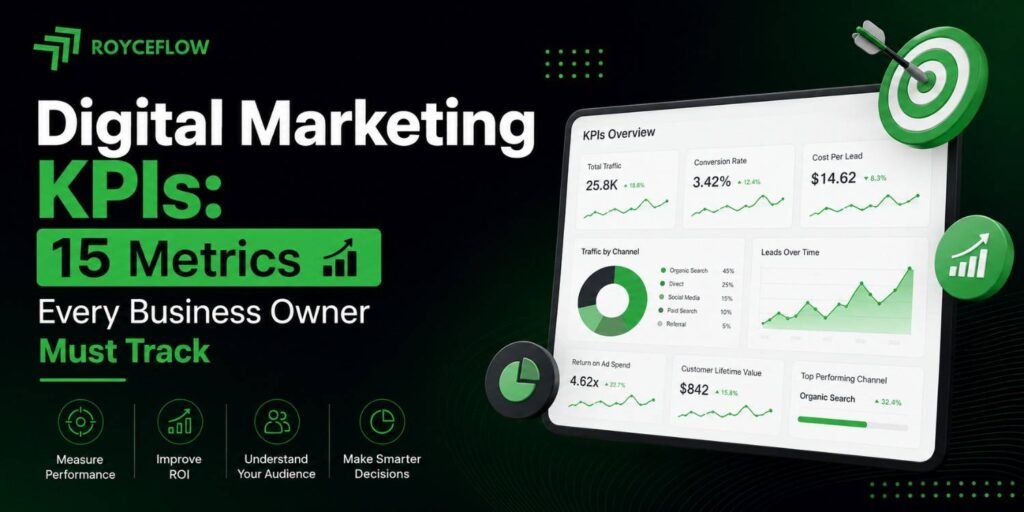
Digital marketing isn’t just about running ads, posting on social media, or publishing blogs. The real measure of success lies in tracking the right Key Performance Indicators (KPIs). These metrics help you understand what’s working, what isn’t, and where to invest your marketing budget for better results.
Whether you’re a small business owner or managing a large enterprise, monitoring the right digital marketing KPIs can improve your return on investment (ROI) and support smarter business decisions.
Let’s explore the 15 most important digital marketing metrics every business owner should track.
What Are Digital Marketing KPIs?
Digital Marketing KPIs (Key Performance Indicators) are measurable values that show how effectively your marketing campaigns are achieving business goals.
These metrics help answer questions like:
- Is my website attracting visitors?
- Are my ads generating leads?
- Which marketing channel performs best?
- Is my content converting customers?
- Am I getting a positive return on investment?
Tracking KPIs allows businesses to optimize campaigns based on real data instead of assumptions.
Why Tracking KPIs Matters
Monitoring digital marketing performance helps businesses:
- Measure campaign success
- Improve marketing ROI
- Understand customer behavior
- Reduce wasted ad spend
- Increase conversions
- Make data-driven decisions
- Identify growth opportunities
Without KPIs, it’s difficult to know whether your marketing efforts are delivering meaningful results.
1. Website Traffic
Website traffic measures the number of people visiting your website over a specific period.
Monitor:
- Total visitors
- Unique visitors
- Returning visitors
- Traffic trends
Growing traffic usually indicates increasing brand awareness and successful marketing efforts.
2. Traffic Sources
Knowing where visitors come from helps identify your best-performing marketing channels.
Common traffic sources include:
- Organic Search
- Direct Traffic
- Social Media
- Paid Ads
- Referral Websites
- Email Marketing
This information helps allocate marketing budgets more effectively.
3. Conversion Rate
Conversion rate measures the percentage of visitors who complete a desired action.
Examples include:
- Filling out a contact form
- Purchasing a product
- Booking a consultation
- Downloading a guide
- Signing up for a newsletter
Higher conversion rates indicate an effective website and marketing strategy.
4. Cost Per Lead (CPL)
Cost Per Lead measures how much it costs to generate one qualified lead.
A lower CPL means your marketing campaigns are acquiring leads more efficiently.
Businesses should compare CPL across different channels to determine where to invest more.
5. Customer Acquisition Cost (CAC)
Customer Acquisition Cost measures the total amount spent to acquire a new customer.
It includes:
- Advertising costs
- Marketing software
- Sales expenses
- Agency fees
- Campaign costs
Keeping CAC lower than customer lifetime value is essential for sustainable business growth.
6. Customer Lifetime Value (CLV)
Customer Lifetime Value estimates the total revenue a customer generates throughout their relationship with your business.
Higher CLV means customers continue buying from your business over time, increasing profitability.
Improving customer retention often has a greater impact than acquiring new customers.
7. Bounce Rate
Bounce rate measures the percentage of visitors who leave your website after viewing only one page.
A high bounce rate may indicate:
- Slow loading pages
- Poor user experience
- Irrelevant content
- Weak landing pages
Optimizing website speed and content can reduce bounce rates.
8. Average Session Duration
This metric measures how long visitors stay on your website.
Longer sessions generally suggest:
- Engaging content
- Better user experience
- Valuable information
- Effective website structure
Businesses should aim to increase user engagement over time.
9. Click-Through Rate (CTR)
CTR measures the percentage of people who click on your ads, emails, or search results after seeing them.
CTR is important for:
- Google Ads
- Facebook Ads
- Email campaigns
- Search engine listings
Higher CTR usually indicates compelling headlines, visuals, and calls to action.
10. Organic Search Traffic
Organic traffic represents visitors who find your website through search engines without paid advertising.
Increasing organic traffic indicates:
- Strong SEO performance
- Valuable content
- Higher search rankings
- Better online visibility
Organic traffic often delivers long-term business value.
11. Keyword Rankings
Tracking keyword rankings helps measure your visibility on search engines.
Monitor:
- High-value keywords
- Local keywords
- Product keywords
- Service keywords
Improved rankings often lead to increased organic traffic and leads.
12. Social Media Engagement
Social media engagement measures how audiences interact with your content.
Important metrics include:
- Likes
- Comments
- Shares
- Saves
- Followers
- Reach
High engagement indicates that your content resonates with your audience.
13. Email Marketing Performance
Email marketing remains one of the highest ROI digital marketing channels.
Track:
- Open rate
- Click rate
- Unsubscribe rate
- Conversion rate
- Email list growth
Regular analysis helps improve campaign performance.
14. Return on Ad Spend (ROAS)
ROAS measures how much revenue your advertising generates compared to the money spent.
A strong ROAS indicates profitable advertising campaigns and efficient budget allocation.
Businesses should monitor ROAS across platforms such as Google Ads, Meta Ads, and LinkedIn Ads.
15. Return on Investment (ROI)
ROI measures the overall profitability of your digital marketing activities.
It considers:
- Revenue generated
- Marketing investment
- Operating costs
- Customer acquisition
A positive ROI confirms that your marketing efforts are contributing to business growth.
Best Tools for Tracking Digital Marketing KPIs
Several tools help businesses monitor marketing performance effectively.
Popular options include:
- Google Analytics 4
- Google Search Console
- Google Ads
- Meta Ads Manager
- LinkedIn Campaign Manager
- HubSpot
- SEMrush
- Ahrefs
- Hotjar
- Microsoft Clarity
Using multiple tools provides a complete picture of marketing performance.
Tips for Tracking KPIs Effectively
To get meaningful insights:
- Set clear business goals.
- Track only the metrics that align with your objectives.
- Review KPIs regularly.
- Compare month-over-month and year-over-year performance.
- Build dashboards for easier reporting.
- Use data to optimize campaigns continuously.
- Avoid focusing on vanity metrics alone.
Consistent tracking helps identify trends and opportunities before they impact results.
Common KPI Tracking Mistakes
Many businesses struggle because they:
- Track too many metrics without clear goals.
- Ignore conversion data.
- Focus only on website traffic.
- Fail to monitor customer retention.
- Don’t measure ROI.
- Rarely review campaign performance.
- Make decisions without analyzing data.
Avoiding these mistakes leads to more effective and profitable marketing.
Final Thoughts
Digital marketing success isn’t determined by how much content you publish or how many ads you run—it’s determined by measurable results. Tracking the right KPIs allows you to understand customer behavior, improve campaign performance, and maximize your marketing investment.
By regularly monitoring these 15 essential metrics, businesses can make informed decisions, reduce wasted spending, improve conversions, and achieve sustainable long-term growth.
Frequently Asked Questions (FAQs)
1. What are digital marketing KPIs?
Digital marketing KPIs are measurable metrics that help businesses evaluate the performance and effectiveness of their online marketing campaigns.
2. Which KPI is the most important?
The most important KPI depends on your business goals. For lead generation, conversion rate and cost per lead are key. For eCommerce, ROAS, customer acquisition cost, and customer lifetime value are often the most important.
3. How often should KPIs be tracked?
Most businesses should review key metrics weekly for active campaigns and conduct a more detailed monthly performance analysis to identify trends and opportunities.
4. What tools can I use to measure digital marketing KPIs?
Popular tools include Google Analytics 4, Google Search Console, Google Ads, Meta Ads Manager, HubSpot, Ahrefs, SEMrush, Hotjar, and Microsoft Clarity.
5. Why is ROI important in digital marketing?
ROI measures how much profit your marketing activities generate compared to the money invested. Tracking ROI helps businesses determine whether their campaigns are financially successful and where to allocate future marketing budgets.